Is there really such a massive difference between the effects of modern weed and real old-school landraces?
Yes!
Five decades of mindlessly breeding for THC % has ended up with the dreary, boring, flat effect typical of generic Dutch–American cannabis.
All that extra THC has come at the expense of hundreds – or more likely, thousands – of other phytochemicals, not just minor cannabinoids, terpenoids, esters, and alcohols….
So ‘potency’ is not a good concept for thinking about the increased levels of THC in modern bud.
‘Increased potency’ denotes that the amount of a substance needed to achieve an effect is smaller.
And that’s exactly not what’s going on here.
Compare the effect of some generic Dutch–American bud with loads of THC (say 25% THC) to a tropical landrace with less – say a 15% THC landrace from a ganja region like Lao or Orissa.
A typical ganja landrace will have a radically different effect: first the intensely stimulating rush, likely strong aphrodisiac effects, likely a strongly psychedelic edge in the sense of a powerful shift in subjectivity.
The buzz will probably persist for a good three to four hours too, especially if you’re toking resin from a good Nepali charas landrace with a bit of CBD in the mix.
Crucially, there’s a very broad spectrum of effects in landraces, because there are many different regions and different types within regions.
So –
Ignore the sock-puppet stuff on forums about how a landrace isn’t a landrace when it’s outside its region.
Landrace varieties have intrinsic characteristics that are inherent to their genetic profile.
The fact that they will express themselves more or less well depending on region and conditions (soil, climate, technique etc.) makes them no different from any other cannabis variety.
Would the forum gobshites argue that ‘Skunk No.1’ isn’t ‘Skunk No.1’ if it’s not in the desert outside San Diego or in Amsterdam?
Of course not…
Skill is essential to raise good cannabis from any cannabis variety, modern or traditional, and the species Cannabis itself shows immense phenotypic plasticity.
Don’t let ‘idiot-farming’ grifters on forums throw you with half-baked, half-understood puff about terroir, which is the next term from agronomic jargon set to get ‘griftified’ by cannabusiness ‘entrepreneurs’.
Yes, it is true that, as with a crop such as tea, altering an environmental factor such as altitude can cause even a clonal cannabis cultivar to exhibit very marked changes in relative expression and concentration of secondary metabolites, which happens when higher elevations alter epigenetic mechanisms and metabolic pathways. Likewise, there is a universal consensus among Himalayan cannabis farmers that higher altitude equates with charas with a greatly enhanced resin profile, as just one example…
But all this is about terroir and does not change the facts of the genetics: landraces are landraces and genomics work is indicating that their populations are very well-defined at the genetic level.
***
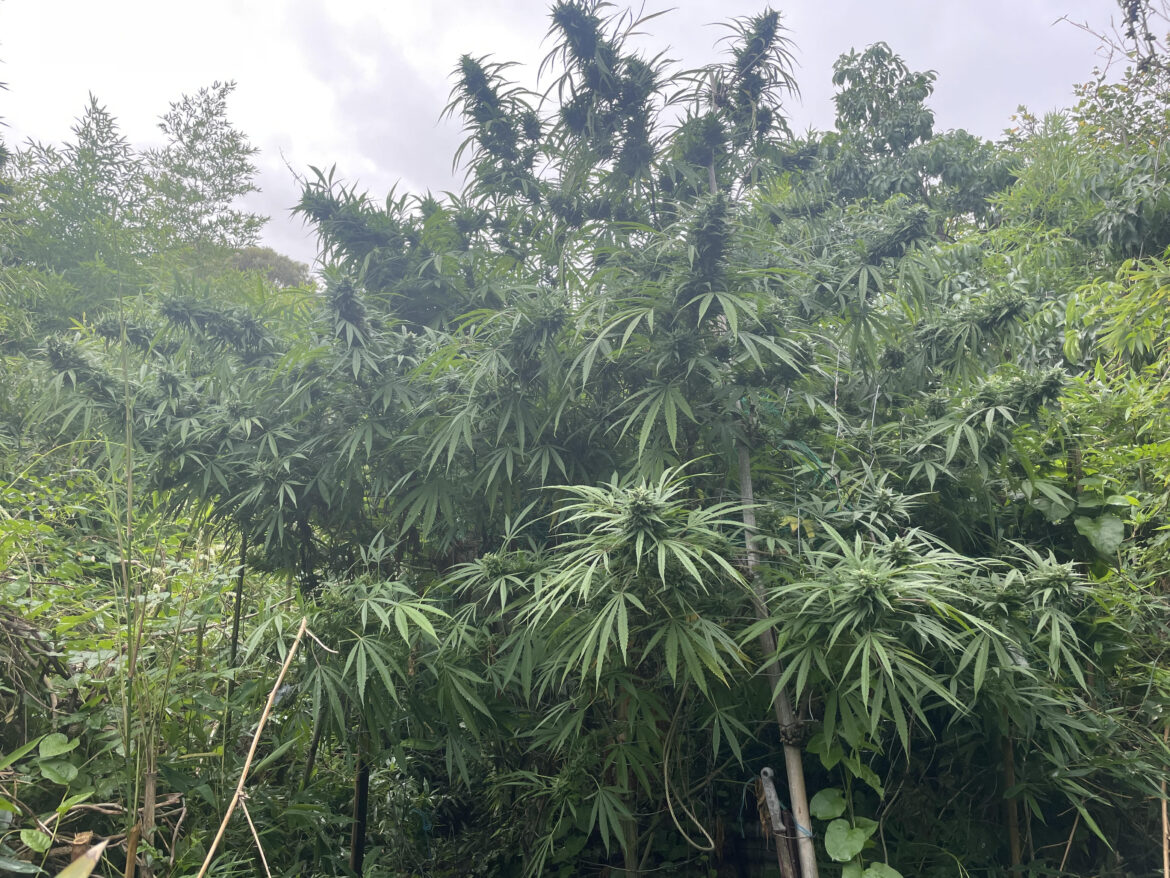
The photo shows our Burmese landrace in the tropical Americas.
Related Posts
 Documentary – 1970: The Year That Changed Cannabis in America Forever
 Ganja plant ready for cutting – Bengal, India (1894)
 Dervishes – Samarkand, Central Asia (1870s)
 Stoned sadhus smoking ganja – Rajasthan, India (1780s)
 Nepali Highland – a ganja landrace from east Bengal?
 Stoned Ramblings: Cannabis & Psychogeography