Born at the western extremes of the world’s first superpower, Herodotus was a Greek historian of the 5th Century BCE, his birthplace on the Mediterranean coast of Anatolia (Turkey) a small satrapy within a Persian Empire that stretched all the way to the Ganges Plains of north India and the distant desert steppe of Central Asia.
Among aficionados, Herodotus is best known for bringing us history’s first account of cannabis intoxication, which involved the funeral rites of the Scythian nomads on the Black Sea Steppe of what is now Ukraine.
His greatest work, The Histories, a long and psychedelically intricate account of the origin of the Greco-Persian Wars and the diverse cultures of the ancient world, is the founding historical narrative of western literature.
What a reader today can find in the The Histories is an enlightened pluralism from which our modern world has much to learn, plus humour, scope, meticulous research, eyewitness accounts from Herodotus and others, and of course, superb stories….
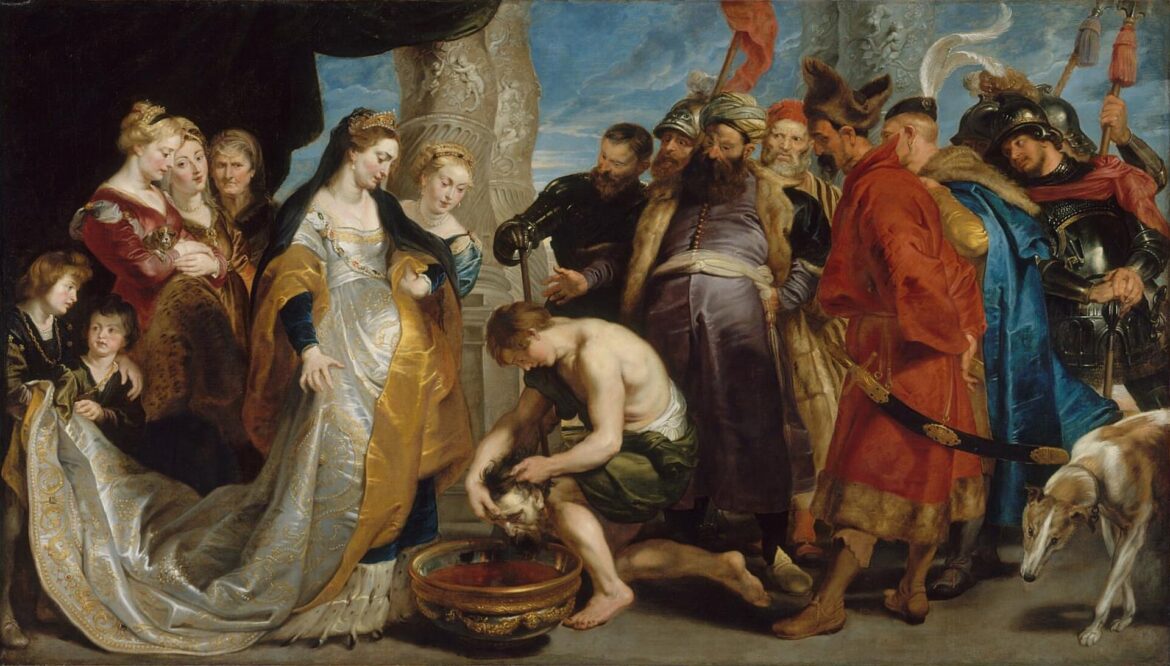
The painting shown above is The Head of Cyrus Brought to Queen Tomyris by the 17th Century Flemish painter and diplomat Rubens, based on an episode from Book I of The Histories.
Queen Tomyris was the leader of the Massagetae nomads, an Iranic nomad federation much like the Scythians. Around 530 BCE, it’s said that Emperor Cyrus the Great of Persia invaded Central Asia, where he brought about the death of the son of Tomyris by trickery using wine and drunkenness, after which, in her rage, Tomyris led the Massagetae to rout the Persian imperial army in a brutal battle.
Tomyris then ordered Cyrus’s decapitated head plunged into a wineskin filled with blood, famously telling the corpse of the most powerful man in the world, “I live and have conquered you in war, and yet by you am I ruined, for you took my son with guile; but thus I make good my threat, and give you your fill of blood.”
Thereafter, Tomyris used Emperor Cyrus’s skull as a goblet, sliced along the top like a cup and no doubt gilded in gold, as was the custom among the nobility and warriors of Eurasian Steppe nomad federations such as the Xiongnu and the Scythians.