First, just to clear up that freebie seeds with all orders at The Real Seed Company and Kwik Seeds are currently Kumaoni (12 seeds) and Nepali Highland #3 (5 seeds).
Kumaoni is a Himalayan multipurpose landrace cultivated for use as fibre, grain, and drugs (‘intoxicant’ or medicinal). This multipurpose landrace type is from the ethnic Khas (‘Pahari’ or ‘Pahadi’) cultural zone that runs from Kumaon district in the Indian Himalaya to Gandaki Province in the Nepali Himalaya, the full extent of which reaches as far west as Himachal Pradesh and as far east as Kathmandu Valley.
Nepali Highland was collected in Gandaki Province in Nepal but is an entirely different landrace type specialized for the production of ganja (sinsemilla or lightly seeded flowering tops). A lot points to its origin being about 600 miles to the east on the eastern frontier of Bangladesh and Northeast India.
***
Genomic analysis and other evidence such as police crop eradication videos suggest that ‘Nepali Highland’ is in fact a ganja landrace from eastern Bengal. To hazard a guess, its origin is probably the Sylhet–Barak region once known as the Surma Valley, a zone of connectivity formed by a river network between east Bengal (Bangladesh) and Northeast India (Assam, Manipur, and Mizoram).
The architecture of ‘Nepali Highland’ appears to be consciously selected for ‘stealth’ production. Plants could very easily blend with and be mistaken for tall grasses or bamboo. In other words, this looks like a domesticate that developed in the context of prohibition.
In South Asia, that context reaches as far back as the 1800s, when the East India Company and the British Raj implemented license systems for the Indian cannabis market (i.e., colonial extractive capitalism / tax farming). This resulted in parallel illicit ganja economies based on concealed cultivation and smuggling. In the Surma Valley, a predominantly ethnic Bengali region where recreational and ritual use of cannabis were common throughout most classes and castes of society, legal ‘excise ganja’ was readily available through government-licensed vendors. But Bengal’s geography made for a thriving trade in illicit ganja, especially further east where its abundance of rivers meets the highland jungles of ‘Zomia’.
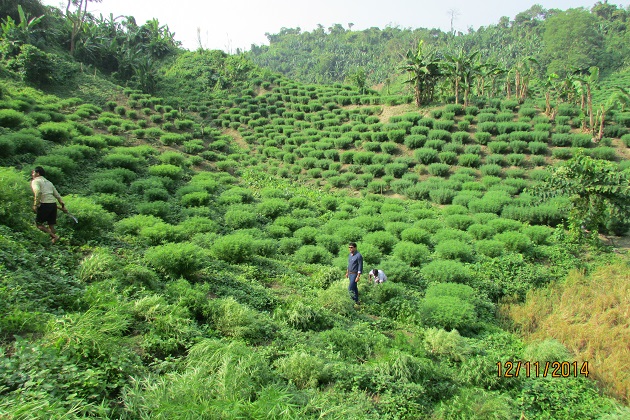
In the photo above, the ‘Nepali Highland’ landrace can be seen clipped to look like tea bushes in Tripura, just across the south-eastern border of Bangladesh (east Bengal). One of the smallest of the ‘Seven Sister’ states of Northeast India, Tripura sits on the periphery of a global centre of tea production: Assam. The roots of this ganja variety may well reach back to the introduction of commercial tea production to Assam under the British Empire. The tea trade continues to be a grim, exploitative business, but here at least we have something positive: India and Britain’s shared love for tea (‘ek cup chai’ / ‘a nice cuppa’) meets India and Britain’s increasingly shared taste for cannabis.
By the 1880s, much of the ganja cultivation that occurred in the Surma Valley was ‘under license’. But the core of the legal ‘excise ganja’ economy was the Ganja Mahal (primarily Rajshahi District) in the north-west of Bengal, close by the cities, markets, and administrative centres of the densely populated plains of northern India. Illegal ganja production had meanwhile extended far to the east, tracking the expansion of the British colonial state into Assam: rail networks, tea estates, coal mines, and above all the movement of people. ‘Foreigners’ – in the language of the time – as opposed to the ‘native’ Assamese, this new influx of Indian migrant labourers, military, and bureaucrats brought with them from their homelands in the provinces of central and northern India and Bengal a culture of cannabis. Ganja plots quickly cropped up in worker gardens on tea estates. Commercial-scale fields soon extended deep into the Northeast Frontier Tracts.
The ‘Northeast Frontier’ was the British name for the realm beyond Assam, rolling jungle highlands that reached to the mountains of eastern Tibet and Burma. Ungovernable by nature of its geography, its subregions such as the Naga Hills were home to clans like the Konyak, who proved equally unreceptive to rule by a centralized state. In the Victorian era, the British recognized that this was de-facto nonstate space and largely left the Nagas and other tribes to their own devices, including when it came to growing ganja.
This dynamic of ‘state evasion’ continued to define the ganja economy through WW2 and after Indian independence, accelerated by the collapse of the charas trade between Xinjiang (Central Asia) and South Asia. Demand for charas was met by increased supply of ganja. Smuggling networks fostered cultivation in the lowland and Terai regions of Nepal to supply the markets of northern and eastern India. On the basis of how the cannabis economies of South and Southeast Asia continue to work to this day, it seems highly likely that this involved the introduction of seed by ethnically defined groups from the demand side of the trade, ‘ganja mafias’ and other underground entrepreneurs who control supply chains and enjoy most of the profit. Suffice to say, it looks like our ‘Nepali Highland’ landrace is in fact Bengali.
Related Posts
 Documentary – 1970: The Year That Changed Cannabis in America Forever
 Are the effects of landraces really so different from modern cannabis?
 Ganja plant ready for cutting – Bengal, India (1894)
 Dervishes – Samarkand, Central Asia (1870s)
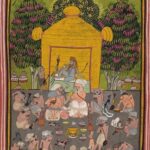 Stoned sadhus smoking ganja – Rajasthan, India (1780s)
 Stoned Ramblings: Cannabis & Psychogeography